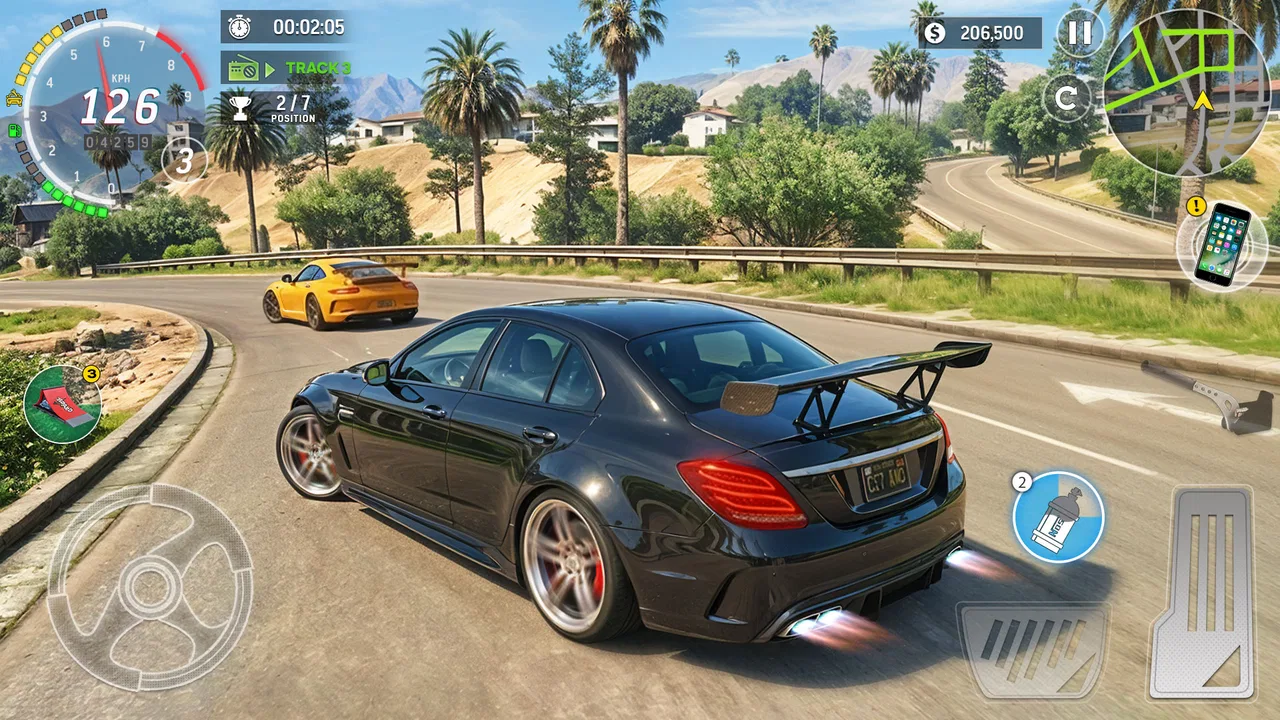
US Car Drifting & Racing Games
- 4.2
- Rating
- 1.00M
- Installs
- Free
- Price

 Analysis by App-foxy
I approached US Car Drifting & Racing Games as a quick, accessible driving game rather than a full simulation. That distinction matters. Its focus is on getting into a car, finding speed, and working through intense tracks with drifting as the main attraction. I found the appeal strongest when I wanted a short session with immediate action instead of a long campaign that demands careful preparation.
The game is developed by Gaming Engine and sits in the role-playing category, although its moment-to-moment play is clearly built around driving. It is free to start, aimed at Everyone, and supports devices running Android 7.1 or later. The current version is 0.2, so I would approach it as a relatively early release whose core idea is more important than a huge amount of polished content.
That early-stage character shapes my recommendation. There is enough here for casual players who enjoy trying to hold a slide, taking another run at a difficult track, and improving through repetition. However, anyone expecting the depth of a dedicated racing simulator, a broad vehicle collection, or a highly detailed progression system should keep expectations realistic. This is best understood as a straightforward mobile drifting experience with a low entry barrier.
You May Also Like

 Blood Strike: 2.5 Anniversary
Blood Strike’s Loadouts Turn Every Drop Into a Tactical Gamble
A close look at Blood Strike’s custom loadouts: how fast access to signature weapons reshapes its battle royale rhythm, rewards preparation, and narrows the gap between fights.

 Pandora - Music & Podcasts
Pandora’s Music Is Easy to Start, but Harder to Recover
Pandora’s strength is its low-effort path from a seed to a station. Its weak spot is how much confidence it asks you to place in connection, setup, and quiet recovery.

 8 Ball Pool
 Is Built on Rivalries, Rematches, and Routine
A close look at the rivalries, rematches, shared routines, and unanswered safety questions that turn a quick pool match into a persistent mobile community.

 Samsung Music
’s Quiet Strength Is Playing What You Already Own
Its reach comes less from spectacle than from dependable access to a personal library. That simplicity is both the app’s strongest retention engine and its ceiling.

 AccuWeather: Weather Radar
AccuWeather Review: A Quick, Clear Forecast for Everyday Decisions
For everyday plans, the best forecast is the one you can understand quickly. AccuWeather makes rain timing, radar, and local conditions easy to act on, with a few trade-offs.

 Hill Climb Racing
Why Hill Climb Racing Still Turns Crashes Into One More Run
A tiny car, a bumpy hill and one more upgrade: Hill Climb Racing keeps resurfacing because its simple chaos makes every near-miss feel personal.
More From Our News Desk



How I built a reliable driving routine
My most useful starting routine was deliberately simple: I began with controlled acceleration, learned how the car reacted before attempting long drifts, and treated each run as practice rather than a race I had to win immediately. That approach made the tracks easier to read. When I tried to force speed from the first moment, I lost control more often and learned less from each attempt.
For a new player, the first few runs are valuable even when they end badly. Pay attention to where the car begins to rotate, how much room is available after a bend, and whether a corner rewards a shallow slide or a more committed drift. The important habit is to change one thing at a time. If you alter steering and acceleration together, it becomes difficult to understand why a run improved or failed.
I also recommend using the opening sessions to establish a comfortable hand position. On a phone, rapid steering corrections can become tiring, especially when the action is concentrated around repeated corners. I had better results when I avoided gripping the device too tightly and made small corrections instead of dramatic swipes. That sounds basic, but consistency is more useful here than frantic movement.
A realistic everyday use case is a short break between tasks. I can imagine playing a few runs while waiting for an appointment or commuting as a passenger, then putting it down without needing to remember a complicated story or a large inventory. The game’s immediate driving focus suits that pattern better than role-playing games that require long sessions to make meaningful progress.
One practical tip is to separate “learning runs” from “score runs.” During a learning run, I deliberately accept slower entries into corners so I can understand the route. During a score run, I use that knowledge to carry more speed. Mixing both goals often leads to unnecessary retries because one mistake feels like a wasted attempt, even though it may have revealed something useful about the track.
Settings that deserve attention before chasing speed
The most important settings are the ones that affect how comfortable steering feels. I would check the available control options before judging the game’s handling. A player who prefers gentle, predictable inputs may enjoy a different arrangement from someone who wants rapid corrections. Even when the underlying car behavior stays the same, a familiar control method can make the difference between a clean line and constant oversteer.
I would also look at sound and visual preferences before extended sessions. Driving games can become tiring when effects are too loud or when the screen is difficult to read in the environment where you are playing. Lowering distractions is not just a comfort choice; it helps preserve attention for the next bend. If I am playing in a noisy place, I prefer a setup that lets me concentrate on the vehicle’s movement rather than depend entirely on audio cues.
Because the game is free, I would be especially deliberate about any purchase prompts. In-app items range from $0.49 to $9.99 each, so I would play the basic experience first and decide whether spending adds meaningful value to my own routine. A free starting point is useful for testing the handling, but it does not automatically mean every optional purchase is necessary. I would avoid buying anything simply because a difficult run felt frustrating.
The age rating of Everyone makes the game easy to consider for a broad audience, but younger players may still benefit from an adult setting limits around purchases. That is a practical point rather than a criticism of the driving itself. If the device is shared, checking purchase controls before handing it over prevents an enjoyable short game from becoming an unwanted expense.
Another setting-related habit is to keep the phone stable. I found that the smallest changes in how I held the device affected my steering rhythm. Resting it securely rather than constantly shifting its position helped me reproduce successful inputs. This is particularly useful for players who play one-handed or switch between portrait and landscape habits during the day.
Faster patterns that improve consistency
The quickest improvement came from thinking about corners in stages. I aimed to enter under control, initiate the slide at a repeatable point, and then prioritize the exit. Many failed drifts were not caused by the start of the turn; they failed because I stayed focused on the spectacle of the slide and forgot that the car still needed to be pointed toward the next section.
I found it helpful to use shorter corrections near the end of a drift. Large movements can rescue a mistake, but they can also create a second mistake immediately afterward. When a car begins to rotate too far, a measured correction is usually easier to repeat than a sudden reversal. This is one of the clearest differences between simply moving quickly and developing a dependable driving pattern.
Another strong habit is to memorize decision points rather than trying to memorize every visual detail. I look for the moment when I need to begin turning, the point where I should reduce the slide, and the place where acceleration becomes safe again. That creates a compact mental sequence. It is more useful than relying on a vague feeling that a corner “looks right.”
Players who want faster results should resist restarting after every small error. Completing a damaged run can teach more about the later parts of a track than repeatedly perfecting the opening. I usually allow myself a full attempt, note the section that caused trouble, and then focus on that section during the next run. This turns repetition into targeted practice instead of an endless series of identical restarts.
There is also a trade-off between showy drifting and efficient driving. A wide slide may feel rewarding, but it can cost the speed needed for the next straight. I would use larger drifts when the track gives enough room and keep the car calmer in narrow sections. The best run is not always the one with the most dramatic angle; it is the one that preserves control from one challenge to the next.
For a short daily routine, I would use three phases. First, make one relaxed run to remember the route. Second, repeat the most troublesome corner with a single adjustment. Third, attempt a full run while keeping that adjustment. This routine is more productive than playing until frustration takes over, and it fits the game’s pick-up-and-play nature.
Where the early version reaches its limits
The current version, 0.2, is the clearest reason to keep the review balanced. The game can deliver quick drifting sessions, but I would not choose it for the deepest long-term racing experience. Players who need a large competitive ecosystem, detailed simulation physics, or a substantial role-playing progression loop may find the design too light. A more established racing title would be a better choice for that audience.
The role-playing label may also create expectations that the driving itself does not fully satisfy. I would not install this expecting character development or a story-led adventure to carry the experience. Its identity comes from the tracks, speed, and repeated attempts to improve a run. That is not a problem when approached on its own terms, but it is an important distinction for anyone browsing several role-playing games.
Long sessions can expose another limitation: repetition. The same basic actions—accelerating, steering, drifting, correcting, and trying again—are enjoyable when I am chasing a better result, but less satisfying when I want constant novelty. The game works best in compact bursts unless the player genuinely enjoys refining technique. If you prefer exploration, narrative surprises, or a wide variety of non-driving activities, this will probably feel narrow.
Device compatibility is relatively approachable because Android 7.1 is supported, but compatibility alone does not guarantee an identical experience on every phone. Screen size, touch response, and performance can influence how precise steering feels. I would give the game a fair trial on the device I actually plan to use rather than judging it from another phone with different controls or responsiveness.
The free price lowers the risk of trying it, while the optional purchase range means players should decide in advance how they want to handle spending. I see the free entry as the main advantage for curious users. The trade-off is that players who dislike purchase prompts or prefer a single upfront payment may feel more comfortable with a premium alternative that has a clearer cost structure.
The public response is encouraging but not overwhelming: the game has a 4.2 average from around 877 ratings, with over 1 million installs. I read that as evidence of real interest rather than proof that it will suit everyone. The rating supports giving it a chance, while the modest version number reminds me to evaluate the actual driving feel instead of assuming it already matches larger, more mature games.
Who should install it and who should choose something else
I would recommend it to someone who wants a free Android driving game that can be understood quickly. It is a good fit for casual players, fans of drifting clips and high-speed turns, and anyone who enjoys improving through repeated attempts. It also suits people who prefer learning a small set of controls rather than managing a complicated garage or a dense set of systems.
It is less suitable for a player who wants realistic motorsport strategy. If your ideal session includes tire management, detailed tuning, strict race regulations, or a large online competition scene, I would look at a specialized racing simulator instead. Likewise, if you want a story-heavy role-playing game, the category label should not be the deciding factor; the actual appeal here is driving practice and track action.
I would also skip it if I dislike repetition. The game rewards patience, and improvement depends on noticing small differences between attempts. Someone who wants immediate variety may enjoy an arcade racer with more modes, while someone who wants calm exploration may prefer a different kind of mobile game entirely.
For families, the Everyone rating makes the game broadly approachable, and the simple premise is easy to explain. I would still supervise purchases on a shared device because free games with optional items require a little attention from the account holder. That small precaution keeps the low-cost entry point genuinely low-risk.
My verdict after settling into the driving
After using a repeatable routine, checking comfort settings, and treating each corner as a technical problem rather than a button-mashing challenge, I found the game more enjoyable than its brief premise might suggest. Its strongest quality is immediacy: I can start driving quickly, practice a specific section, and feel a clear difference when my inputs become calmer.
The best reason to try it is the combination of free access and focused drifting practice. It does not need a complicated structure to provide a useful short session. The experience makes sense for a player who wants speed and sliding without committing to a large simulator or a long role-playing campaign.
My reservations are equally clear. The early version limits how confidently I can recommend it to players seeking a deep, finished racing package, and the repeated-track format will not satisfy everyone. Optional purchases also deserve a conscious approach, especially for younger or shared-device users. Those are manageable concerns, but they should be part of the decision rather than hidden behind the excitement of fast cars.
Overall, I would recommend US Car Drifting & Racing Games to casual Android players who enjoy learning by repetition and want a free way to experiment with drifting. I would not present it as a replacement for a full racing simulator or a story-rich role-playing game. For short breaks, quick retries, and the satisfaction of finally holding a difficult corner, though, it has a clear and worthwhile place.
FAQs for US Car Drifting & Racing Games
01What is US Car Drifting & Racing Games?
US Car Drifting & Racing Games is a mobile driving game focused on American-style cars, street racing, and controlled drifting. After exploring its events and driving modes, I found that the main appeal is practicing slides, completing races, and improving vehicle performance. It is designed for players who enjoy arcade-style racing rather than a fully realistic simulator.
02Can I play US Car Drifting & Racing Games offline?
The game may allow some driving and racing activities without a constant internet connection, which is useful when traveling or playing with limited data. However, certain features can depend on online services, including advertisements, updates, leaderboards, cloud-related functions, or additional content. It is best to launch the game once while connected before relying on offline access.
03Does the game offer car customization and upgrades?
Yes, customization and vehicle improvement are important parts of the experience. Depending on the available mode and progression, players can typically adjust the appearance of their cars and improve performance to handle races and drifting more effectively. Upgrades can make a noticeable difference, although some vehicles, items, or enhancements may require in-game currency or continued progress.
04Is US Car Drifting & Racing Games suitable for beginners?
The game is generally approachable for new players because its arcade-style controls are easier to understand than those in advanced racing simulators. Beginners can start by learning acceleration, braking, steering, and drift timing in less demanding events. Nevertheless, maintaining a long drift and winning faster races requires practice, especially when managing speed around sharp corners.
05Are there advertisements or in-app purchases in US Car Drifting & Racing Games?
Like many free-to-download mobile racing games, US Car Drifting & Racing Games may include advertising and optional in-app purchases. Advertisements can appear between activities or be offered as rewards, while purchases may provide currency, cars, upgrades, or other conveniences. Before downloading, review the current store listing and your device’s purchase settings, particularly if children may play.
Pros
- Responsive drifting controls make cornering feel smooth and satisfying.
- Several cars offer different handling styles for varied racing preferences.
- Short races are convenient for quick gaming sessions.
- Simple menus make the game easy for new players to navigate.
- Offline play is useful when you have no internet connection.
Cons
- Some cars and upgrades may require significant grinding to unlock.
- Ad interruptions can reduce the pace between races.
- Vehicle physics occasionally feel inconsistent during sharp turns.
- Track variety may become repetitive after extended play.
- Graphics can look dated on newer
- high-resolution devices.

US Car Drifting & Racing Games
Gallery